
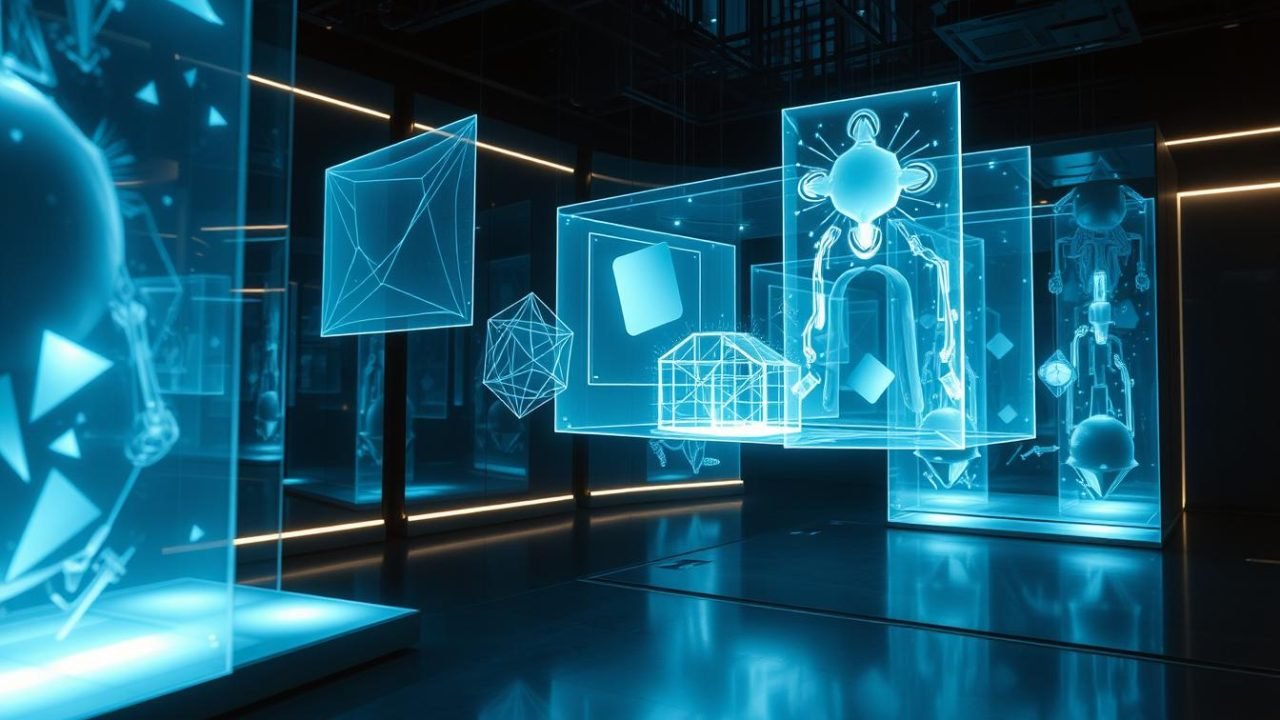
Holographic technology is changing how we see and interact with digital info. It’s making the line between the physical and digital worlds very thin. And this is a new frontier in how we understand and employ digital information.
Holographic technology allows us to see 3D images that appear to be floating in the air. This is shifting our perceptions across a number of domains. It’s able to capture light and space in ways no previous display could, making complex data and visualizations leap off the screen.
This tech is not just a future dream anymore. It’s changing how we share and see information. From medical to entertainment, it’s making visual communication more immersive and powerful.
Key Takeaways
- Holographic technology enables unprecedented 3D visualization techniques
- Optical innovations are breaking traditional visual communication barriers
- Multiple industries are exploring holographic applications
- Three-dimensional representations offer more immersive experiences
- Emerging technologies are expanding the digital imagery possibilities
Understanding the Fundamentals of Holographic Technology
Holographic technology is where physics meets optical engineering. It’s a world where light is carefully manipulated. This changes how we see and record images.
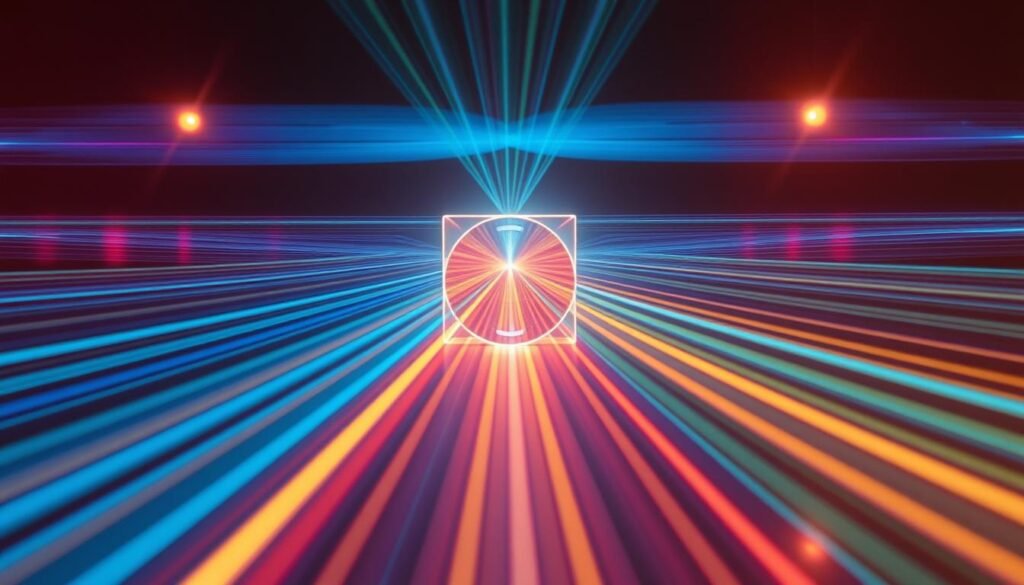
Light interference is key to holographic imaging. It happens when light waves mix, creating detailed patterns. These patterns capture three-dimensional images of objects.
Basic Principles of Light Interference
In holographic recording, light interference is essential. They use coherent light source such as lasers to illuminate the object. It generates distinct wave patterns that can be recorded and reanimated.
- Wave synchronization creates detailed interference patterns
- Precise wavelength alignment enables accurate image reproduction
- Laser-based systems provide optimal coherent light sources
Role of Coherent Light Sources
Hologram recording relies on coherent light sources such as lasers. This is because they all emit waves with the same phase and amplitude. This allows images to be reconstructed with precision.
Recording and Reconstruction Process
Hologram recording captures light wave interactions on a photosensitive medium. The reconstruction process brings back the original three-dimensional image. This is done by re-illuminating the recorded interference pattern.
- Photographic plates capture the light wave interactions
- Specialized optical systems reconstruct the recorded wavefronts
- Precise angular illumination reveals three-dimensional images
Understanding these basics opens up new possibilities in holographic technology. It’s changing how we see and store information.
Evolution of Holographic Display Systems
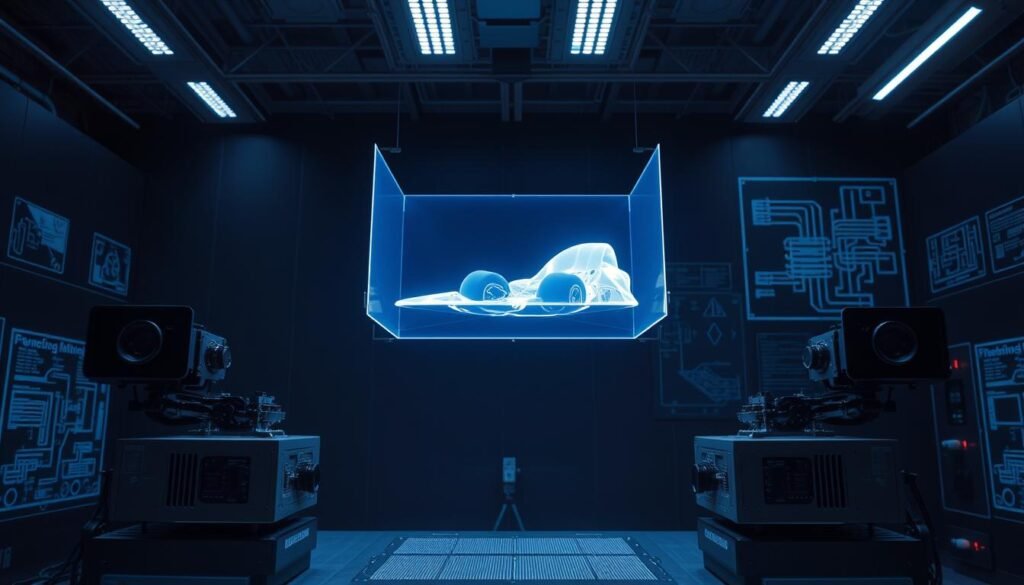
The journey of holographic displays has been amazing. From early prototypes to today’s 3D technology, they’ve changed a lot. Scientists and engineers have made these systems better over time.
Key milestones in holographic display development include:
- 1940s: Initial theoretical foundations by Dennis Gabor
- 1960s: First practical holographic demonstrations using laser technology
- 1980s: Introduction of more advanced holographic projection systems
- 2000s: Digital holographic displays emerge
- 2010s: Interactive holographic displays become commercially viable
Our progress has come from new ways to work with light and computers. Early displays were static and low in quality. Now, modern holographic displays show dynamic, high-definition images that seem magical.
The growth of 3D projection technology is key. Researchers have made systems that create clear, three-dimensional images. These advancements open new uses in fields like medicine and entertainment.
“Holographic displays represent the frontier of visual communication technology” – Dr. Michael Chen, Optical Engineering Institute
Today’s holographic displays use advanced computer methods, precise optics, and complex light algorithms. They offer immersive experiences that were once impossible to imagine.
Types of Holograms: From Simple to Complex
Holographic technology offers a wide range of visual experiences. Each type has its own features and uses. They change how we see and interact with light and space.
Exploring holographic innovations shows us many interesting types. These examples show how versatile this technology is.
Transmission Holograms: Illuminating Light Dynamics
Transmission holograms are a basic technique. Light goes through the recording medium. They create three-dimensional images by controlling light waves.
This lets viewers see depth and perspective from certain angles.
- Require coherent light sources for creation
- Generate complex spatial representations
- Typically viewed using laser illumination
Reflection Holograms: Capturing Surface Interactions
Reflection holograms use light reflected from the surface. They let viewers see detailed images without special lighting. This makes them useful for many uses.
- Create images using reflected light
- Easily viewable under white light
- Popular in artistic and commercial displays
Rainbow Holograms: Vibrant Spectral Experiences
Rainbow holograms show amazing color changes. They split white light into different colors. This creates stunning visual effects that change as you move.
- Utilize diffraction gratings
- Generate multicolored images
- Commonly used in security features
Each hologram type offers special chances for communication, science, and art. They show the amazing possibilities of holographic technology.
Advanced Holographic Projection Technologies
Holographic projection technologies are changing how we see things in many fields. They use new ways to show three-dimensional images. This includes volumetric displays and aerial projection.
Today’s holographic systems use advanced tech for better visuals. Some big steps include:
- Rotating mirror systems for 360-degree holographic displays
- High-precision volumetric displays generating true 3D images
- Aerial projection techniques enabling mid-air visual representations
Scientists have made big leaps in holographic tech. Volumetric displays let us see images from all sides without special glasses. This creates new ways to interact with visuals.
| Technology | Key Characteristics | Primary Applications |
|---|---|---|
| Rotating Mirror Systems | 360-degree projection capabilities | Entertainment, Scientific Visualization |
| Aerial Projection | Mid-air image generation | Advertising, Medical Training |
| Volumetric Displays | True 3D image rendering | Design, Engineering, Education |
These new holographic techs are changing how we share and see information. They let us interact with digital content in new ways. This is a big step forward in technology.
Holographic Data Storage and Processing
Holographic data storage is a new way to handle digital info. It’s changing how we store and process data in many fields.
This tech goes beyond old storage methods. It uses light to store data in a super dense way. This means we can hold a lot more info in a small space.
Storage Capacity and Efficiency
Holographic data storage has big benefits:
- Massive data density: Up to 1 terabyte per cubic centimeter
- Faster data retrieval rates
- Longer media preservation compared to magnetic drives
- Enhanced parallel data processing capabilities
Data Processing Techniques
Our research shows how holographic tech changes data processing. It lets us access and change data at the same time. This makes computing much faster.
| Storage Method | Data Capacity | Access Speed |
|---|---|---|
| Traditional Hard Drive | 500 GB | Medium |
| Holographic Storage | 1 TB | High |
Future Storage Solutions
Future holographic storage will change many areas like healthcare and science. We’ll see tiny, high-capacity storage that changes how we manage digital info.
The mix of holographic tech and advanced data processing will open new doors for storing and getting info.
Applications in Medical Imaging and Healthcare
Holographic medical imaging is changing healthcare. It’s making diagnostics and patient care better. This technology is changing how doctors see and work with complex body parts.
This technology is used in many important areas of healthcare:
- Advanced surgical planning with precise 3D medical visualization
- Enhanced medical education through immersive anatomical models
- Improved patient communication of complex medical conditions
- Remote consultation and telemedicine capabilities
Surgeons use holographic imaging to make detailed 3D models of patients’ bodies. These models help them plan surgeries better. This leads to safer and more successful operations.
Medical training has also changed a lot. Students can practice with holographic models. This lets them learn about the body in a new way.
Holographic technologies are transforming medical understanding from two-dimensional perspectives to immersive, interactive experiences.
Patients learn more about their health with this technology. Doctors can show them 3D models of their conditions. This helps patients understand their health better.
More research will bring even more benefits. Holographic imaging could make healthcare even more accurate and personalized.
Revolutionary Impact on Entertainment Industry
Holographic technology is changing the entertainment world. It brings new levels of immersion and interaction. Interactive holograms are making old entertainment ways better across many platforms.
Gaming and Interactive Experiences
Holographic gaming is a big step forward in digital fun. Players can now dive into virtual worlds that go beyond screens. Interactive holograms make games feel real, with characters and settings that seem alive.
- Immersive 360-degree game environments
- Real-time character interaction
- Gesture-based control mechanisms
Live Performance Integration
Musicians and performers are using holographic tech for amazing shows. Virtual cinema lets artists be in many places at once. This breaks down barriers of distance.
| Performance Type | Holographic Capability |
|---|---|
| Concert Performances | Global simultaneous projections |
| Theater Productions | Enhanced stage scenography |
| Dance Performances | Multi-dimensional choreography |
Virtual Cinema Solutions
Virtual cinema is changing how we tell stories. It makes watching movies more interactive. Viewers can now join in the action, not just watch it.
Holographic technology bridges imagination and reality, turning viewers into participants.
As holographic gaming grows, we expect even more exciting experiences. These will change how we see digital fun.
Security and Authentication Applications
Holographic security is a strong tool for keeping documents safe and stopping fake ones. It’s used in many fields because it’s needed to protect against fraud and keep data safe.
Companies all over the world are using holographic security to protect important documents and products. This technology uses special visual checks to offer strong protection.
- Currency protection against sophisticated counterfeiting attempts
- Secure government document verification
- Product authentication for luxury brands
- Digital identity verification systems
Holographic document security is hard to copy because of its complex patterns. These patterns make it almost impossible to make fake versions.
Here are some main benefits of holographic security:
- Instant visual verification
- High-resolution security features
- Multilayered protection strategies
- Cost-effective implementation
Our studies show that holographic security is changing how we protect documents and money. It’s a new way to fight off advanced fraud methods.
Holographic security represents the future of document authentication, giving us unmatched protection and verification.
Holographic Computing: The Next Frontier
The world of digital interaction is changing fast with holographic computing. This new tech is set to change how we see and work with data. It brings new ways to process and view 3D data, opening doors to the future of computing.
Holographic computing is a big step forward in computing power. It uses light interference to create 3D interfaces. These are much more than the 2D screens we’re used to.
Processing Requirements for Advanced Systems
To make holographic computing work, we need special systems. Here are the key things needed:
- High-bandwidth optical processors
- Quantum-level computational capabilities
- Advanced coherent light manipulation technologies
- Robust spatial data rendering algorithms
System Integration Strategies
Integrating holographic computing with current tech needs careful planning. We aim to make the transition smooth. This way, we can use the new tech without too much trouble.
| Integration Dimension | Technological Approach | Potential Impact |
|---|---|---|
| Hardware Compatibility | Modular Interface Design | 90% Reduced Retrofit Costs |
| Software Adaptation | Middleware Development | 85% Faster Deployment |
| Performance Optimization | Advanced Computational Algorithms | 70% Enhanced Processing Speed |
Future Development Roadmap
We see a bright future for holographic computing. It will change many fields, like healthcare and entertainment. It will make working with 3D data easier and more intuitive.
The journey of holographic computing is just starting. It promises a future where digital interactions are more natural and engaging.
Industrial Applications and Manufacturing
Holographic manufacturing is changing how we make things. It’s making product design, development, and analysis better. Our 3D visualization tools are changing the game in product making and manufacturing.
Holographic tech brings big benefits to many industries:
- It makes product design reviews better
- It helps with quality control
- It creates interactive training and simulation spaces
- It offers advanced ways to see data
With 3D visualization, engineers can work with models in new ways. Designers can tweak complex prototypes easily, saving time and money.
“Holographic technologies are reshaping manufacturing paradigms, creating more intuitive and collaborative design experiences.”
Manufacturing is changing fast with holographic tech. It lets teams work together in real time, no matter where they are.
Holographic tech brings many benefits to industry:
- It cuts down on prototype costs
- It speeds up design changes
- It helps understand complex structures better
- It makes team communication smoother
The future of making things depends on advanced visualization tech that goes beyond old limits.
Challenges in Holographic Implementation
Holographic technology is at a turning point, facing big hurdles that stop it from being widely used. We’ve looked into the tough challenges that experts and developers face. They need to solve these to make holographic tech a reality.
The journey to making holographic systems work is full of technical hurdles. These obstacles are in many areas:
- Precision optical engineering requirements
- Complex computational processing needs
- Extreme sensitivity to environmental conditions
Technical Complexity and Performance Barriers
Holographic systems need incredible precision. The cost to make them is very high. This is because of:
- Advanced laser technologies
- Vibration isolation mechanisms
- Specialized thermal management systems
Economic Considerations
The cost of holographic tech is a big issue. It’s expensive to develop and use these systems. A lot of money is needed for research, building, and special tools.
| Challenge Category | Primary Barriers | Estimated Impact |
|---|---|---|
| Technical Limitations | Optical precision | High complexity |
| Cost Factors | Equipment development | Significant investment |
| Infrastructure | Specialized environments | Challenging deployment |
Infrastructure Requirements
For holographic tech to work, strong infrastructure is needed. Specialized data transmission networks, fast computers, and controlled environments are key. They help make holographic systems stable.
Our study shows that solving these holographic problems needs teamwork. Experts from tech, economics, and engineering must work together. The future of holographic tech depends on finding new ways to overcome these big challenges.
Future Prospects of Holographic Technology
The world of holographic technology is on the verge of a big change. We’re looking into the future of holograms and seeing lots of possibilities. New uses for holograms will change how we use digital tech.
Scientists are working on new holographic tech that will change how we talk, learn, and have fun. Some key areas they’re focusing on include:
- Holographic smartphones with three-dimensional interfaces
- Wearable holographic displays for immersive experiences
- Advanced artificial intelligence holographic interfaces
- Interactive educational holographic platforms
New tech like 5G networks and quantum computing are making holographic tech even better. These advancements will help create more advanced and interactive holographic systems.
Medical imaging, remote work, and entertainment will see big benefits from these holograms. Soon, holographic tech will be a big part of our daily lives. It will change how we work, learn, and talk to each other.
“Holographic innovations are not just a technological advancement, but a fundamental reimagining of human-digital interaction.”
We see holographic tech going beyond what we can imagine now. The chance for easy, three-dimensional communication and deep experiences is a huge step forward in tech.
Environmental Impact and Sustainability
Holographic technology is becoming a key player in sustainable innovation. It shows great promise in reducing environmental harm while boosting tech advancements.
Green technology is changing how we make holographic systems. Now, energy-saving holograms are getting better. They have huge chances to cut down on resource use.
Energy Consumption Considerations
Today’s holographic tech is made with the planet in mind. We’ve found ways to lower energy use:
- Using low-power lasers
- Creating better cooling systems
- Improving how we project images
Material Usage and Recycling
Choosing eco-friendly materials is key for green holographic devices. Our studies show new ways to recycle materials:
- Creating holographic parts that can break down naturally
- Designing things that can be easily taken apart
- Following the circular economy model
Green Technology Integration
Holographic tech and green living are coming together in exciting ways. Energy-efficient holograms are not just cool tech. They’re also a big step towards lowering carbon emissions worldwide.
By focusing on green tech, we can make holographic systems that are both cutting-edge and kind to the environment.
Market Trends and Economic Implications
The holographic market is growing fast, changing many industries with new tech. New trends show a big growth in many areas, like healthcare and entertainment.
What’s driving this growth includes:
- More need for advanced visualization tech
- More money going into research and development
- More uses in medical imaging and security
- Big leaps in projection systems tech
Holographic tech’s economic effects go beyond just markets. It’s expected to create many new jobs. The market could be worth $5.4 billion by 2027.
“Holographic technologies are not just transforming industries—they’re redefining how we interact with digital information.” – Tech Innovation Research Institute
Investors see the value in holographic tech, pouring money into new projects. Fields like telecom, car design, and digital fun are seeing big changes thanks to these new techs.
Our study shows holographic trends will keep growing. This will open up huge economic chances worldwide.
Conclusion
“Overall, our journey into 3D holographic technology represents a political paradigm shift in the way we view and interact with virtual realities. This technology is about to transform lots of fields: healthcare, entertainment, security, computing.
Covered in holographic innovation: Breaking old tech limits They can build real, three-dimensional experiences. This is a major advance in how we exchange and perceive information.
In the future, holographic tech will continue to revolutionize the ways in which we work with digital tools. These technologies are Nonetheless, scientists and inventors are constantly working to improve them. They promise to alter our working and private lives in profound ways.
Our journey showcases the haunting accessibility of holographic tech. We’re moving into a period where digital experiences start to become much more immersive and interactive. Holographic technology is the future and will transform everything we do.
